
Tokaji: The Wine of Kings, Made for the Family Table
Mālō e lelei, fellow wine explorers.
This week I want to take you somewhere unexpected.
Not France.
Not New Zealand.
Not Australia.
Hungary.
Yes, Hungary.
And the wine we are talking about is one of those names that catches you off guard the first time you see it on a label. It’s a country I would love to share with you and let you all know it exist and I recommend you keep an eye out for. Ofa, you will love this wine style because I know you like taking a digestive beverage after a big meal.
How do you say Tokaji.
Tokaji = toh-KYE
The “Tok” sounds a little like talk, and the ending sounds like kai, like food in Aotearoa.
Toh-kye. Easy. Done. Don’t let the name sit on the shelf and scare you an
A bottle I’ll never forget
Years ago, when I was studying wine in Burgundy, a French family I had become close with invited me back to their home after a long Sunday lunch.
You know the kind of Sunday I mean.
Long table.
Long lunch.
Long conversation.
After the cheese, after the coffee, the father stood up and disappeared into a little wooden cabinet in the corner.
He came back with a small, slim bottle. Golden. Almost glowing.
Tokaji Aszú
He poured small glasses for each of us.
The wine was honey gold, sweet but not heavy, with this incredible lift of acidity that kept it fresh.
Apricot.
Honey.
A little orange peel.
A whisper of smoke.
I had never tasted anything quite like it.
He looked at us and said something I’ve never forgotten:
“This one is for the end. For the people you love.”
That moment stayed with me.
So, what is Tokaji?
Tokaji is one of the great historic wines of the world, from the Tokaji region in northeast Hungary.
For centuries, Tokaji was known as the wine of kings, courts, and tsars. Louis XIV of France famously called it:
“Wine of Kings, King of Wines.”
The most famous style is Tokaji Aszú – a beautiful golden sweet wine made from grapes affected by noble rot.
But Tokaji is not only sweet.
Today, winemakers in Tokaji also produce dry white wines, especially from the grape Furmint, fresh, mineral, high in acidity, and full of lovely fruit.
Apple.
Pear.
Lemon.
A little smokiness from the volcanic soils.
So when you see Tokaji on a wine list, it could go a few ways.
A dry white – bright, lively, and food-friendly.
Or a sweet wine – golden, generous, and a perfect end to a meal.
Both deserve a place at the table.
The native grapes of Tokaji
Now here’s something special.
Tokaji is not just about one grape.
For a wine to carry the Tokaji name, it can only be made from six approved native grape varieties.
These grapes belong to the region. They are part of its identity, its history, and its flavour.
The main one is Furmint.
But there are five others that also play their part.
Furmint – pronounced FOOR-mint
Hárslevelű – pronounced HARSH-level-loo
Kabar – pronounced KAH-bar
Kövérszőlő – pronounced KUH-vair-sue-loo
Zéta – pronounced ZAY-tuh
Sárgamuskotály – pronounced SHAR-guh-moose-koh-tie
So while Furmint is the star, Tokaji is really a team effort.
And you know me – coming from rugby, I love that.
One grape might wear the number 10 jersey, but the whole team has to do its job.
So how does Tokaji get so sweet?
Here is the part that surprises people.
The sweetness in Tokaji does not come from adding anything.
It comes from something that sounds like it should be thrown away.
Rot.
But not the bad kind.
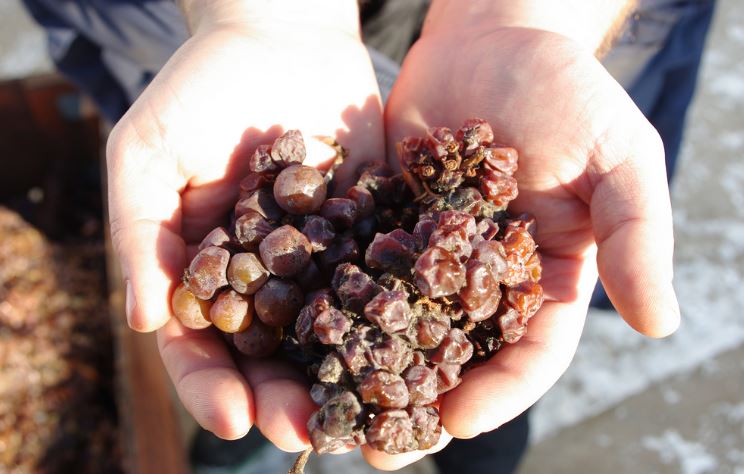
This is noble rot.
Its proper name is Botrytis cinerean – a special fungus that settles on the grapes in the misty autumn mornings of the Tokaji region.
Aszú berries.
And here is the beautiful part.
They are picked by hand, one berry at a time, because not every grape shrivels at the same pace.
That is slow work.
Patient work.
Careful work.
It is a big reason real Tokaji Aszú is so special and honestly, why it is not cheap.
When you taste that honey, that apricot, that richness, you are tasting patience.
You are tasting a season that did its job properly.
Wine Chief takeaway
Now, I won’t bore you with all the different styles produced in Tokaji, because there are a few.
Dry wines.
Late harvest wines.
Sweet Aszú wines.
Different levels, different traditions, different labels.
But what I really want you to know is this:
Tokaji is a region worth being aware of.
It is one of those wine regions that carries history, patience, and real craft in every bottle.
So don’t let unfamiliar names stop you.
Tokaji is one of those wines you can be quietly proud of knowing.
It’s not on every shelf in Auckland yet, but it is appearing more often on good wine lists – especially at restaurants that care about discovery.
And if you ever see Tokaji Aszú on a wine list or in a bottle shop, pause for a second.
That little golden bottle may have a much bigger story than you think.
Now, let me be honest with you.
Here in New Zealand, a proper bottle of Tokaji is not cheap. I would love to have one in my hand more often than I do.
But once you understand the noble rot, the hand-picking, and the patience behind every drop, the price starts to make sense.
You are not really paying for a bottle. You are paying for a whole season of careful work.
If you want to track one down here in Auckland, two stores I would point you to are Glengarrys and United Cellars.
Final pour
A Hungarian wine.
A memory from a French Sunday.
Wine doesn’t really care where you come from.
It just asks you to sit down, slow down, and share.
Mālō ‘aupito,
Semisi – The Wine Chief