
Destiny Bay: Where the Vines Come First
A quiet midday on Waiheke, a warm welcome, and a winery that keeps its eyes on the vineyard.
Mālō e lelei and bonjour, fellow wine explorers.
Last week I caught the ferry to Waiheke.
It wasn’t a holiday. I was preparing a private experience for a special guest, and that meant walking the ground myself.
Meeting the people. Tasting the wines. Standing in the rows.
Over the coming weeks I’ll take you through the wineries I visited. There were a few, and each one has a story.
This week, we start at Destiny Bay Waiheke Island.
A welcome worth crossing the water for
Ella met me at the vineyard. From the first handshake, I felt at home. No script. No rush. No fluff.
Just genuine warmth, and real pride in the place she works.
Growing up in a Tongan home in Glen Innes, I learned early that how you receive a guest says everything about you. Ella received me like family.
She took me out into the vineyard first. We walked the rows, and she showed me what was happening in the vines this time of year: the new season’s growth, and the care that goes into every block.
Then she led me down to the room where the magic happens
Dark. Cool. Quiet.
Rows of barrels lined up side by side, the wine inside slowly ageing away, taking its time.
And then the smell hit me.
That deep, earthy mix of oak, wine and cool stone.
I stopped for a second. I told Ella that this was the exact smell of the deep cellars I used to walk through in Burgundy.
One breath, and I was back there.
Different country. Same smell. Same magic.
Some memories live in photos. The best ones live in your nose.
A working vineyard, not a show
Here’s what struck me most.
Destiny Bay has no big tasting room. No tour-bus car park. No gift shop by the door.
It’s a working vineyard. People with their hands in the soil.
The vines sit in a natural, bowl-shaped amphitheatre at the southern end of the island, sloping down toward the water. It’s a sun trap. Every block is tended and picked by hand.
The family story is a lovely one. Mike and Ann Spratt came from the United States looking for a home, not a vineyard. Ann wondered if the bowl might suit a few vines. Today their son Sean makes the wine.
Small production. Fewer than 2,500 cases a year. Three Bordeaux-style blends of Cabernet Sauvignon, Merlot, Cabernet Franc, Malbec and Petit Verdot.
Magna Praemia (MAG-nah PRY-mee-ah). Mystae (MISS-tay). Destinae (DESS-tin-ay).
Hold those names. We’ll come back to them.
Less time on the show. More time on the vines. That’s where great wine is made.
It took me back to Burgundy
Standing in those rows, I was back in Burgundy.
It reminded me of the winemakers I came to know while studying at the Burgundy School of Business in Dijon and playing amature rugby for Nuits Saint Georges
Their doors weren’t built for tourists. Their days belonged to the vineyard.
And you could taste that care in every glass.
Different country. Different grapes. Same heart.
And I love that.
The vines were flowering
When I arrived, the vines were flowering.
Maybe a little early. But it’s the season, and it’s a great sign.
Flowering is when the tiny flowers on each vine are pollinated and set into berries. It’s the first promise of the next vintage. Kind weather now means a healthy crop come harvest.
Seeing it in person, with someone who tends those vines every day, is a gift.
Three Wines, One Great Year
I promised I’d come back to the wines. Here they are.
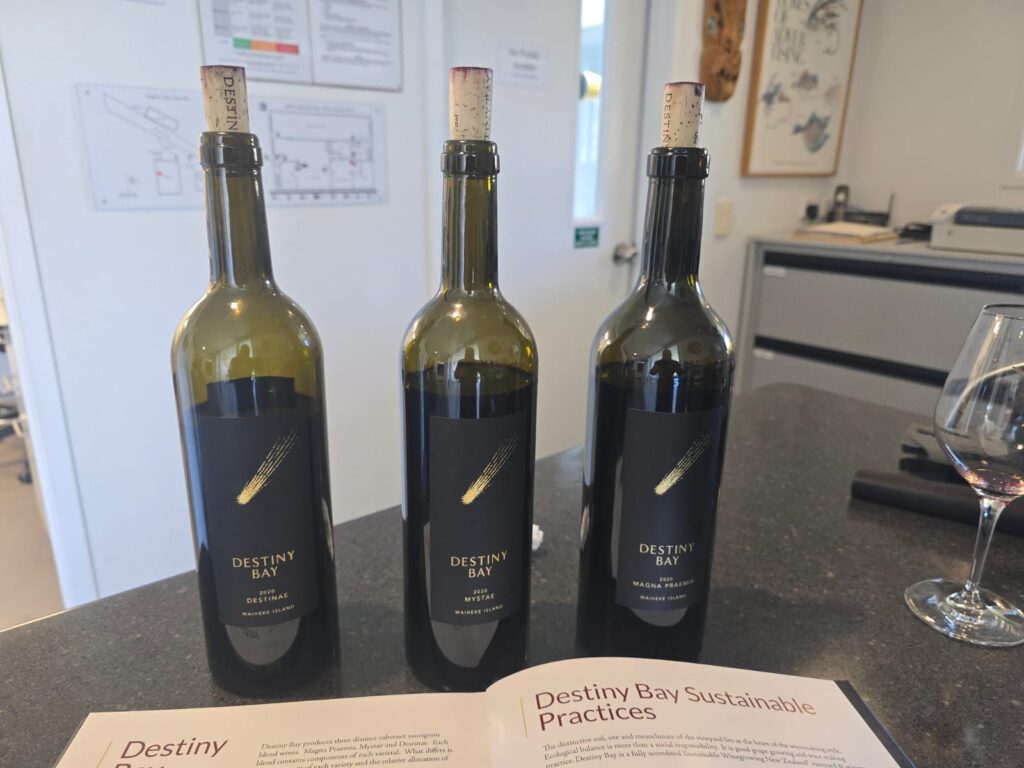
Ella poured me three Destiny Bay wines, all from 2020.
Same vineyard. Same year. Three very different stories.
Destinae 2020 (DESS-tin-eye) opened the flight. It’s the most approachable of the three: generous dark fruit, soft tannins and an easy warmth. It’s the wine that welcomes you in.
Mystae 2020 (MISS-tie) came next, and the conversation deepened. There was more layering, more spice and more structure, with the fruit holding back a little and letting the earth and the oak speak.
Then came Magna Praemia 2020 (MAG-nah PRY-mee-ah), the flagship, and the “great reward” its Latin name promises. It had density, power and length, with flavours that kept unfolding long after the glass was down.
Why does that matter?
Because tasting all three side by side is the best lesson in complexity I know. Each step up the ladder added another layer.
And 2020 was a special year in Auckland and on the islands. It was warm, dry and sunny, with clean, ripe fruit that let the winemakers pick when they chose, not when the weather forced them.
You can taste that in the glass. These wines are already delicious today.
But here’s the secret.
They’re only getting started.
Give them 10 to 12 years in a cool, dark cellar. The tannins will soften, the fruit will turn to cedar, leather and spice, and the wine will become even more seamless.
It’s like my years in Burgundy. The best bottles were never the ones opened young. They were the ones someone had the patience to wait for.
So if you find a 2020 Destiny Bay, buy two. Open one now. Hide the other.
Your future self will thank you.
Getting the most from a working vineyard
If you visit a small, hands-on winery like this, a few simple things help:
- Book ahead. Small working vineyards often see visitors by appointment. Call or email first.
- Ask what’s happening in the vines this week. Pruning, flowering, harvest. The season shapes the story.
- Walk the rows if you’re invited. The wine makes more sense once you’ve stood where it grows.
- Ask your host their story. Why here? Why these grapes?
- Take a bottle home. Opening it later brings the whole morning back.
- Say thank you. Hospitality is a gift, not a service.
Join the Club
Destiny Bay keeps its best wines close to home through its Patron Club. Members receive an annual allocation of the new releases, offered to them each year before anyone else, with patrons in New Zealand and overseas. It’s the easiest way to secure these small-production wines, and the club also gives you the chance to visit the vineyard and taste with the people who make them. If you fell for the wines above, this is how you make sure they keep coming. Details are on the Destiny Bay website: Patron Club
Wine Chief takeaway: The best visits aren’t measured by the size of the tasting room. They’re measured by the people, the vines, and the time they give you.
Next week, another stop on the Waiheke trail. Until then, find a small grower. Say hello. Listen
Mālō ’aupito, Ella, for a day I won’t forget.
Mālō ’aupito,
Semisi Telefoni — The Wine Chief