
Margan Wines: Barrels, Barbera and a Front-Row Welcome
A rugby handshake, a garden on the plate, and the first Barbera ever planted in the Hunter.
Mālō e lelei and bonjour, fellow wine explorers.
Some winery visits start with a tasting list.
This one started with a rugby handshake.
The day before, our mate Pierre Durand had taken us around the Hunter Valley. Before we parted, he gave us one tip. Go and see Andrew at Margan. Another treat, he said.
He was right.
The Quiet Side of the Hunter
Margan sits in Broke, in the Broke Fordwich subregion. It’s about twenty minutes from Pokolbin, at the far end of Broke Road, under the Brokenback Range.
In 1994 it became the first part of the Hunter recognised as its own subregion.
The Hunter is warm country. Hot summers. Frosty winters. A touch of sea breeze. In summer the nights cool down, and that cool keeps the grapes fresh and bright.
Broke gets a little less rain than Pokolbin, sheltered by the ranges. And the soil? Red volcanic clay called the Fordwich Sill. Andrew says it’s one of the biggest reasons his wines taste the way they do.
We know this in Tonga too. In Ha’apai, the old people know exactly which ground grows the best ‘ufi (yam). Same idea. The French just call it terroir (teh-RWAHR).
A Pokolbin Red with a Bordeaux Past
Andrew’s father, Frank, planted Hunter vines back in 1965. Andrew spent twenty years at Tyrrell’s under the great Murray Tyrrell. He also worked vintages in Bordeaux, and played his rugby there too. Then in 1996 he and Lisa started Margan on their own farm, Ceres Hill.
Today he still turns out for the Pokolbin Reds.
So there we stood. A Tongan boy from Glen Innes who played in Dijon. An Aussie winemaker who played in Bordeaux. Talking scrums before we talked Semillon.
That’s not small talk. That’s common ground.
Rugby opened the gate. Wine kept us at the table.
Straight from the Barrel
Andrew walked us through the winery himself. We tasted straight from the tanks and straight from the barrels.
The highlight for me was a Chardonnay pulled from barrel, just a couple of weeks from bottling. Stone fruit. Tropical fruit. Beautiful texture.
Barrel tasting is like watching a young player at training before his first test. You see the talent before anyone else does. And I love that.
So How Did an Italian Grape Land in the Hunter?
Barbera (bar-BEAR-ah) comes from Piedmont (PEED-mont) in north-west Italy, where it’s the most planted grape. Bright acid. Soft tannins. Dark berries. Made for food.
Its Australian story starts in Mudgee. In 1976 an Italian winemaker from Alba, Carlo Corino, arrived at Montrose and planted Barbera, Nebbiolo and Sangiovese. The story goes the cuttings came over in his suitcase.
In 1998 Andrew took cuttings from those Montrose vines and planted them at Ceres Hill. The first Barbera in the Hunter.
Italy to Mudgee to Broke, by suitcase. Sounds like every Tongan family I know.
Healing the Soil
Andrew talked a lot about the soil. Margan farms regeneratively, using organic and biodynamic practices. Fewer sprays. Cover crops and mulch to feed the ground. Biodynamics is the goal they’re working towards.
The aim is simple. Help the soil recover, give it the right nutrients, and let it grow the best fruit for the best wines.
They say they can taste the difference. After that Chardonnay, I believe them.
So What’s on the Shelf?
Margan’s range is like a good rugby squad. Everyone has a role.
Originals. The wines that launched the Margan name in 1997. Mostly single variety, mostly single vineyard. Easy to love, easy to share. The safe bet.
White Label. The Hunter classics of Semillon, Chardonnay and Shiraz, from vines more than 50 years old. This is the foundation the region was built on.
Single Block. Wines from individual blocks across their vineyards, made in small amounts and only in the best years. This is where the Ceres Hill Barbera lives, along with the Fordwich Hill Semillon and the Timbervines Shiraz.
Breaking Ground. The next generation’s range. Ollie looks at Broke Fordwich with fresh eyes here: Albariño (al-bah-REEN-yo), Barbera, Chardonnay. Textural. Energetic. Young.
Collaborations. One-off wines made with friends in the industry, like a Riesling made with the Huesgen family and Margan’s own vermouth.
Old vines. New ideas. Same soil.
My pick? Start with White Label, then go and find that Barbera.
Lunch from the Same Land
Then we sat down in the restaurant. Margan’s menu is built around their own one-hectare kitchen garden and orchard, plus free-range hens, bees, olive groves and their own lambs.
The food comes off the same land as the wine. Same soil. Same care. Same table.
I felt grateful. Grateful for the meal, the people and the service. Grateful that Andrew gave us his time.
This is exactly what we look for at Premier Ligne. Rugby, wine and food under one roof. Somewhere our clients can feel the story, not just read it.
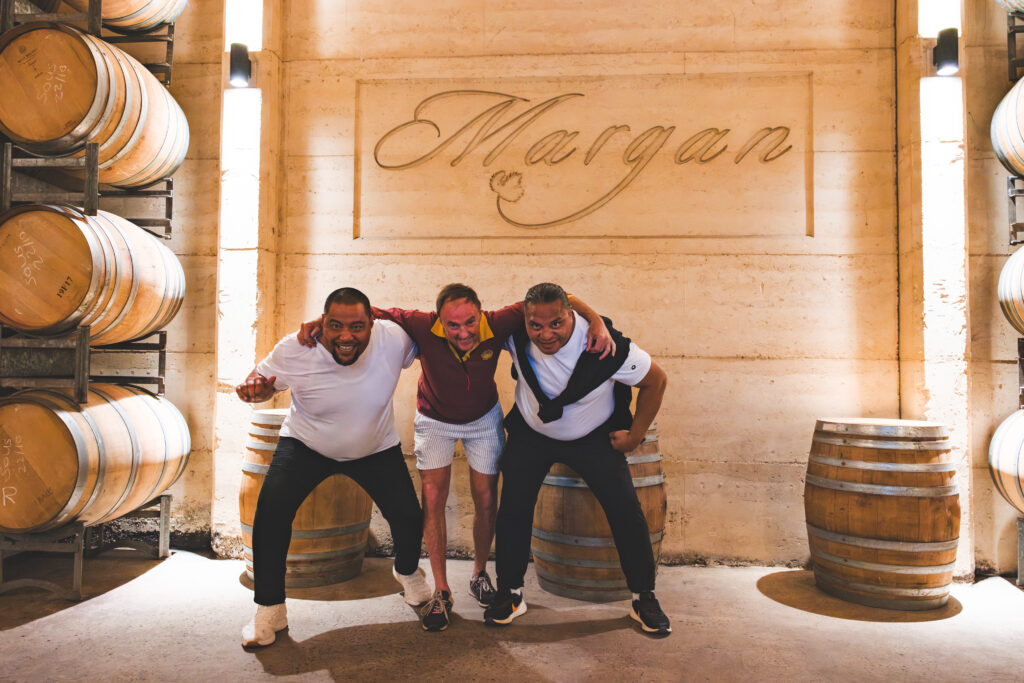
A special mention to James Margan, a hooker, in the photo with Andrew in the middle and Ofa, our loosehead. Ollie couldn’t make it, so that catch-up is on the list. And mālō ‘aupito to Pierre for sending us there.
Final Pour
Wine Chief takeaway: follow the rugby handshake. It usually leads to the best table.
Choose well, drink with joy, and keep it simple.
Mālō ‘aupito
Semisi Telefoni — The Wine Chief
On the map
Where this story takes you
Written by
Semisi Telefoni
The Wine Chief · Co-founder, Premier Ligne 1817
I went from the front row to the first pour. I studied wine in Champagne and Burgundy, and I write here about the bottles, people and places behind every glass. No pretence, no wine snobbery.
thewinechief.co.nz
semisi@thewinechief.co.nz · +64 21 088 47284