A Bottle From 1999: Te Motu and the Pacific Table
How one Waiheke red found its way to our distinguished tongan guests and why a bottle is never just a bottle.
Talofa lava, fellow wine explorers.
Some bottles are opened. Some bottles are offered. This one was offered.
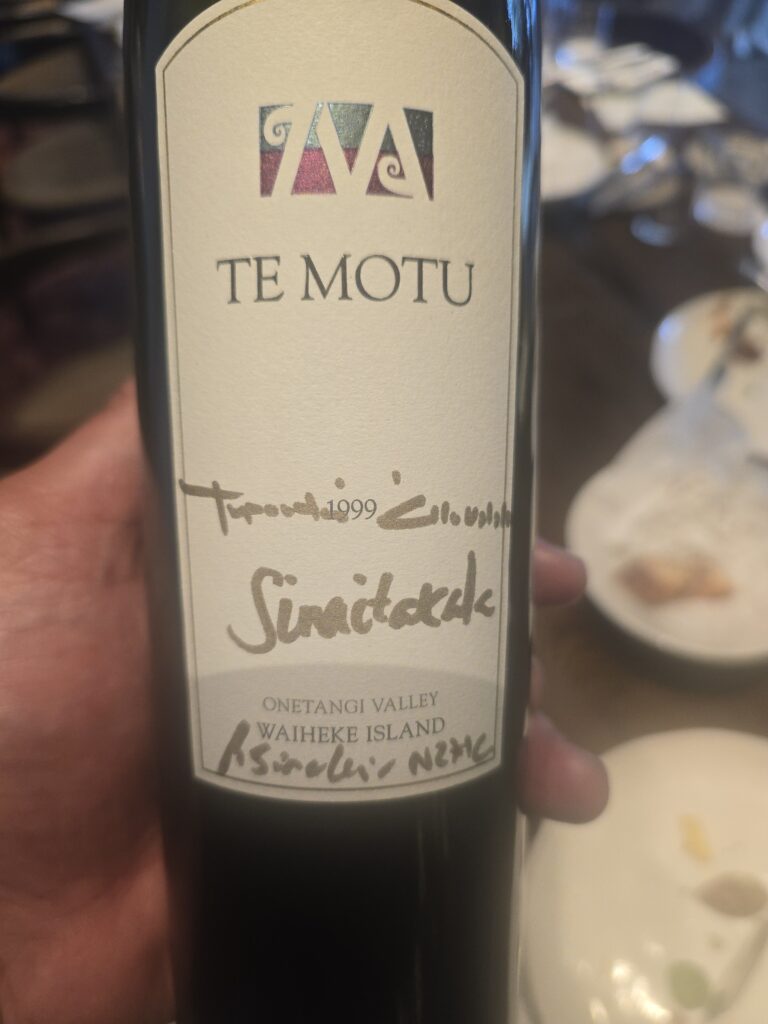
Recently we hosted distinguished guests from Tonga. A special table. A special afternoon. And on that table sat a bottle of Te Motu 1999, a gift from the Dunleavy family of Waiheke Island.
I’ll be honest. I didn’t see it coming.
Three weeks earlier I was on Waiheke for tastings and business. I visited plenty of vineyards. Te Motu was the one I missed. And yet Te Motu found us anyway.
That’s not a coincidence. That’s the Pasifika way.
This is what Premier Ligne 1817 is about
Anyone can pour a good wine. That’s not the experience.
The experience is the moment behind the pour. A Waiheke family, with roots in Samoa, hears that guests from Tonga are coming. So they reach into the cellar and send their 1999. Nobody asked them to. They just knew what it would mean.
That’s the touch you can’t put a price on. The right bottle, with the right story, for the right people.
It turns a dinner into a memory. A tasting into a connection. A guest into family.
That’s what we create at Premier Ligne 1817. Not just wine. Moments like this one.
An island of long shelter
Te Motu takes its name from the old Māori name for Waiheke: Te Motu Arai Roa, “the island of long shelter.”
It’s a family business, plain and simple. In 1988 the Dunleavy family bought land in the Onetangi Valley (oh-neh-TUNG-ee). Brothers Paul and John planted the first vines the next year, inspired by their father Terry, one of the founding figures of New Zealand wine. Their first vintage came in 1993.
They’re still small. Only about 4,500 bottles of the flagship Te Motu are made in a vintage. Today Paul’s son, Rory, runs the estate.
Small vineyard. Big story. Still in the family.
The Pacific thread
Here’s the part that gave me goosebumps.
Before wine, Terry was a journalist. He spent nine years in Samoa editing a newspaper. Five of his children were born there Paul among them. Terry was even embraced as an adopted son of a Samoan aiga, an extended family.
At first, word reached us that Paul was born in Tonga. It turned out to be Samoa. Did it matter? Not one bit.
A Pacific family heard Pacific guests were coming and they sent their best.
In Samoan, that’s fa’aaloalo. In Tongan, faka’apa’apa. Respect. Honour. Showing up for each other.
Different islands. Same ocean. Same table.
So what was in the 1999 bottle?
Te Motu’s flagship is a Cabernet Sauvignon-led blend, with Merlot and Cabernet Franc. Only the best years earn the name. Then the wine rests in bottle for years before it’s released.
1999 was a kind season on Waiheke. Sunny days. Cool winds. Warm nights. The grapes came in clean, between 23 March and 14 April.
Twenty-seven years later, here’s what I found.
In the glass. Deep garnet, just starting to turn brick at the rim. That’s the first sign of age.
On the nose. Dark fruit first. Blackberry and blackcurrant. Then the bottle age arrives: cedar, dried herbs, a touch of earth. No heat. No sharp edges. Just calm.
On the palate. Medium-bodied and really smooth. Not a rough edge anywhere. The blackberry is still there, softer now, more like ripe fruit than fresh. The tannins have melted into a fine, polished grain. They hold the wine together without gripping your gums.
The finish. This is where it got me. Just as the fruit fades, a line of acidity lifts at the very end. Fresh. Clean. It leaves you reaching for the next sip.
The verdict. Balanced. Fruit, tannin and acidity, with not one of them shouting over the others. At just 12.6% alcohol, it never feels heavy. And honestly? It’s not finished. This wine has years left in it.
That’s not an old wine past its best. That’s a wine right in its stride.
That’s the magic of age. A young red shouts. An old red tells you a story.
In Dijon I learned that a mature wine isn’t about power. It’s about patience. This bottle had both: patience in the cellar, and patience in the people who kept it.
From Onetangi to Australia
This bottle opened a door.
Rory and I have been talking about what Te Motu and Premier Ligne 1817 might do together. Bien sûr, I’m excited.
Very soon I’m off to Australia for the Tonga v Samoa game. (Tonga v Samoa. After this story, how could it be anything else?) I’m taking a New Zealand line-up for a tasting with people from the travel industry who rarely get to taste these wines. Paul Pujol of Prophet’s Rock in Central Otago is already confirmed. I’m hoping Te Motu joins the line-up too.
Wine from Aotearoa. Poured by a Tongan. Carried across the Tasman to a Pacific derby. And I love that.
So how do you make a bottle mean something?
You don’t need a 1999 to do this. You need a story.
- Know where it’s from. Read the back label. Who made it? Which valley? Which family?
- Match the bottle to the guest. A connection, a place, a heritage, a memory, turns wine into a gift.
- Say a few words before you pour. One minute is enough. The story is part of the wine.
- Treat older reds gently. Stand the bottle upright for a day. Pour slowly and leave the sediment behind.
- Go and taste the history. Te Motu’s cellar door on Waiheke pours older vintages beside new releases a rare chance to taste time.
Final Pour
Not a score. Not a price tag. A story, offered with respect.
Wine Chief takeaway: the price is on the label. The value is in who you share it with.
Fa’afetai tele lava to Paul, Rory and the whole Dunleavy family. You honoured our guests, and you honoured the Pacific.
Te Motu Wines Website – Click on the link for more information
Choose well, drink with joy, and keep it simple.
Mālō ‘aupito.
Semisi Telefoni — The Wine Chief