
Chenin Blanc: The Wine South Africa Kept for Itself
A grape that left France, found a home at the bottom of Africa, and still costs less than it should.
Mālō e lelei and bonjour, fellow wine explorers.
There’s a week every few years where this whole country turns and looks at South Africa.
This is that week.
The All Blacks are over there now, eight matches through South Africa and the United States, August into September. No Rugby Championship this year. Just the rivalry, standing on its own.
And while everyone else is talking about their scrum, I’ve been thinking about wines of South Africa.
Because South Africa quietly makes one of the best-value white wines on earth. And almost nobody in New Zealand is drinking it.
The grape that left home
Chenin Blanc. SHEN-nin BLAHNK. Say it flat. No drama on the end of it.
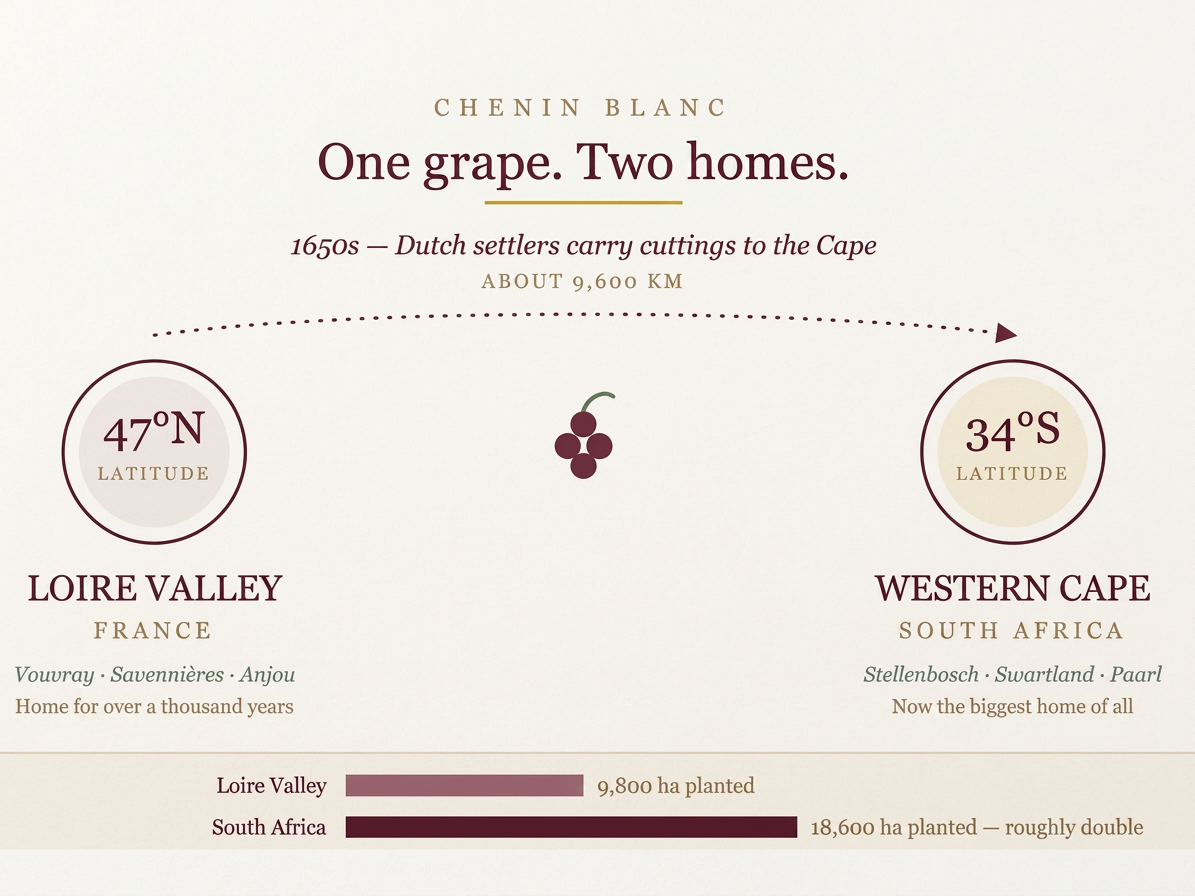
It’s French. It comes from the Loire Valley — Vouvray, Savennières, that cool green stretch of river country in the middle of France. They have been growing it there for a thousand years.
Then in the 1650s, Dutch settlers took cuttings to the Cape.
And something happened that nobody in France planned for.
There is now more Chenin Blanc planted in South Africa than anywhere else on earth. More than in the Loire. Roughly double.
The grape left home. It found different soil, harder sun, a longer season. And it became something bigger than it ever was in the village it came from.
I know a few people like that.
Same grape, two lives
When I was studying in Burgundy, one of our lecturers poured us a Vouvray, dry Loire Chenin. Cold. Tight. A little stern. Beautiful, but it made you sit up straight.
Years later, at a tasting in Auckland, someone put a Stellenbosch Chenin in front of me. Same grape. Completely different animal. Riper. Rounder. Warmer in the mouth, like it had spent the afternoon in the sun.
Same DNA. Two lives.
That is the thing I love about this grape. It doesn’t argue with where you put it. It just becomes what that place needs.
What it actually tastes like
No jargon. Here it is.
Apple. Quince. A little honey at the edges. And a clean line of acid running straight down the middle that keeps the whole thing fresh.
That acid is why it works so well with our food. Fish. Pork. Coconut. Anything with a bit of sweetness or a bit of spice, Chenin doesn’t fight it, it lifts it.
Put a South African Chenin next to a plate of fresh fish and you will understand it in one mouthful. No tasting notes required.
How to buy one this weekend
Three things and you’re away.
- Look for the word “Chenin” or “Steen.” Steen is the old South African name for the grape. Some labels still use it. If you see it, you are in the right place.
- South African means dry. Loire means check. Most South African Chenin is dry and ready to drink tonight. Loire Chenin (Vouvray, Anjou) can be dry, off-dry or sweet, so read the back label if you are going French.
- Don’t spend up. This is the point. Good South African Chenin sits between $18 and $28 in New Zealand. It is one of the last genuinely underpriced wines on the shelf. Stellenbosch, Swartland and Paarl on the label are all good signs.
Buy one. Chill it properly. Open it Saturday with whatever is on the plate.
Wine Chief rule: if it says Chenin Blanc and it’s under $25, you’re getting more wine than you paid for.
The last pour
We will spend this month watching two teams try to take each other apart.
That is the game. I have been in that front row. I know what it costs.
But there is another South Africa sitting on the shelf in your local bottle shop, and it has been waiting a long time for someone to notice.
A French grape. An African home. An Auckland table.
Wine has always been better at crossing lines than we are.
Mālō ‘aupito.
Semisi Telefoni — The Wine Chief